If you have worked with linguists before, you might have noticed that we have a focus on things that you would perhaps consider unimportant or even brush off as a small detail. “My players won’t notice”, you might think.
Oh, but they do.
Back in the old days of the Internet, there were two types of people online — those who cared way too much about grammar and those who made fun of them. If you were around back then, you know how it was.
Here is the thing: all of us linguists belong to the first group. We are obsessed with grammar. And not only with it — we also love to fixate on tone, terminology, conventionality, and really any and all parts of a text. I believe this is simply something you need to have in you in order to become a linguist.
Okay, but why does it matter that we care so much?
There are a few answers to this question.
For a game, there are many windows through which a player can connect and immerse themselves. Gameplay, audio, art, characters, plot, and many, many more.
The game’s text is going to encompass so many of those. And when there is a problem with it, the player is taken away from the game so quickly. This is true not just for video games, by the way. You probably have been through this in some media.
Our brains are trained to spot something wrong and, when it happens, it takes us away from immersion and kind of ruins the experience. Now, a simple typo or a wrongly placed comma isn’t going to spoil the whole game, is it? But what happens when they start to pile up?
A poorly written game is certainly doomed to fail. Just like a bad localization is bound to ruin a game.
Making sure this does not happen is our job, yes, but it is also what we are passionate about. When we spend way too much time discussing something that might seem silly or unnecessary, it is because we see something there, and because we want to make sure nothing goes through us.
We see text like an artist sees a song.
You do not have to be a certified musician to appreciate music, but the people who make it do.
And sometimes they put sounds and instruments that you might have no idea what they are, but when the whole thing comes together, you recognize and enjoy that it is a good song. It is the same for us, game localizers. We are the musicians; you just listen along.
The last reason is my favorite one: a good localization can bring to life a whole new community for a game.
Some regions have tens or even hundreds of thousands of players waiting for a game to come to their mother tongue, which is our whole objective here.
However, I am not talking only about the act of localization, which by itself will open the doors of a game for so many people.
I am talking about when a localization is so good and so on point that it becomes one of the selling points for the game. Yes, it can happen. Games like Cyberpunk 2077, Witcher 3, The Last of Us and even League of Legends are good examples of this.
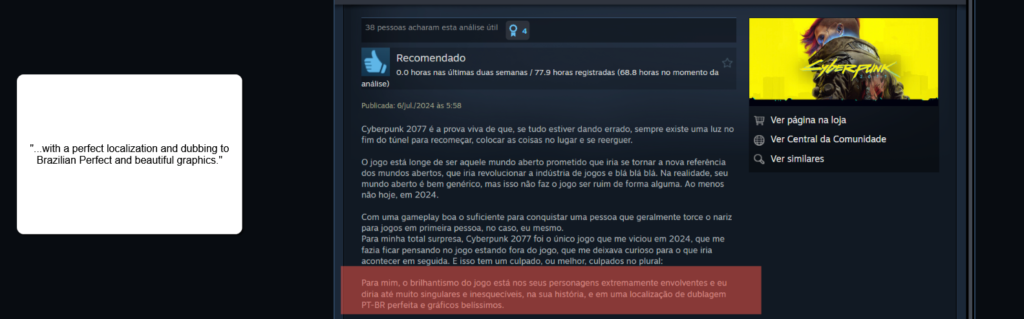

And do not think only AAAs can do a good job.
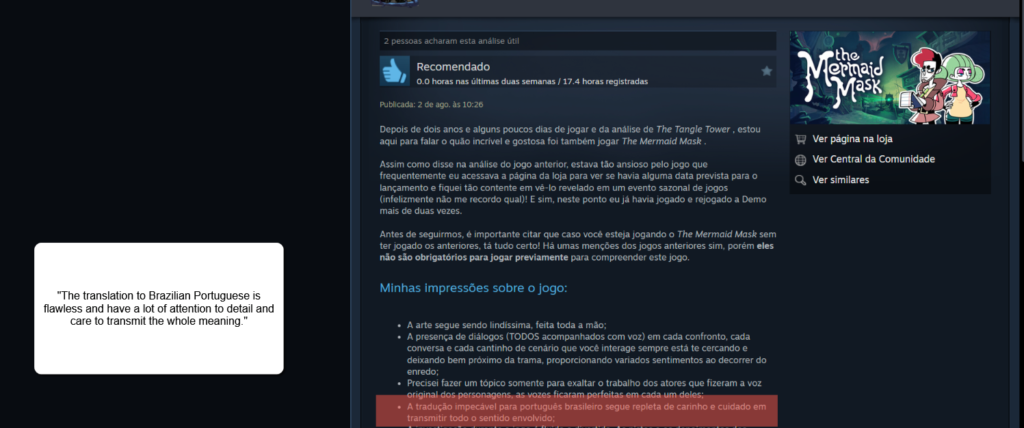
The Mermaid Mask (2026) is a point-and-click mystery indie game that also managed to impress Brazilian fans with its localization quality.
They are living proof that you don’t necessarily need a big budget, just a good localization team.
All these reasons have one common denominator: our obsession.
Being overly fixated on every part of a text might seem unnecessary at first glance. However, for us linguists, obsessing over a comma or a semicolon is not pedantry; it is attention to detail and a will to make the best out of the text.
Caring about the best word out of three synonyms to use in a context is not nitpicking. Checking dozens of times for typos and other small mistakes is not hairsplitting. I could go on and on, but you can already see where I am going.
All of it is simply us aiming as high as we can so the text can achieve its full potential and avoid all of the things mentioned previously. It might look like we care too much about these, but you know what they say:
The devil is in the details.