Have you ever wondered how localizing into Brazilian Portuguese differs from European Portuguese?
Our language has evolved, and comparing BR and EU Portuguese isn’t as simple as comparing US and UK English. Our grammar is different, our accents are different, and the vocabulary, too, can cause serious misunderstandings.
Today, we’re going to take a look at how Brazilian Portuguese requires a cautious approach to be localized, with a focus on our toxic relationship with prescriptive grammar and some differences between Brazilian and European Portuguese.
Geographical and Historical differences
Before we get into the details, it is interesting to point out that the Brazilian population is roughly 20 times larger than Portugal’s: 214 million people vs 10 million in Portugal.
Despite having been colonized by Portugal early in the 16th century, both our language and our culture have not simply been a mimicry of theirs: the natives who were here before their arrival, and the enslaved Africans who were brought by force, have all contributed to the formation and shaping of Brazil’s diverse identity. Fast forward 500 years, and we have become a sovereign country with 26 states (and a Federal District), spanning 8.5 million km² (or ≈ 3.3 million mi², if you will).
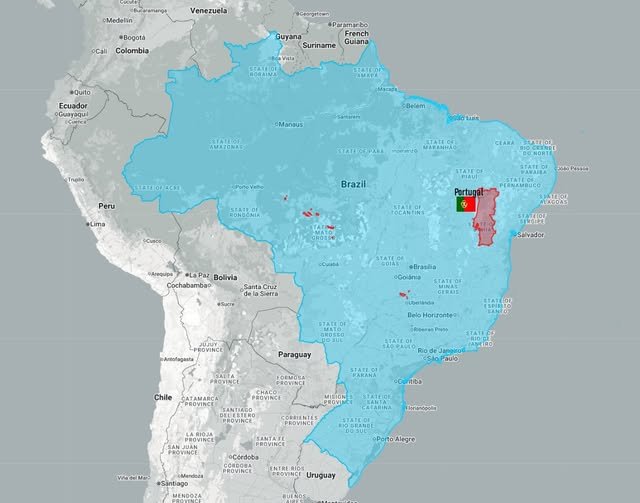
We can fit Portugal 92 times inside Brazilian territory.
Still, how complex is the relationship between Brazilian Portuguese and European Portuguese?
For starters, there is a gargantuan gap between how Brazilians (are supposed to) write and how we actually speak.
Our written grammar is deeply ingrained in the Portuguese tradition, and despite some efforts made by previous governments to standardize and revoke a few outdated rules, “traditional” (or prescriptive) grammar still demands that we mimic what is spoken in Europe.
For example, the sentence “Can I have some coffee?” could be translated to “Me dá um café?” (PT-BR) and “Dá-me um café?” (PT-EU). In the European version, both the written and spoken versions of this sentence would be identical, but Brazilian grammar still expects us to write this sentence following the European tradition, even though everyone in Brazil would always prefer to use the pronoun “me” before the verb “dá” in everyday language.
Brazilian Freestyle
Another interesting example would be the usage of the second-person pronoun.
The Portuguese language allows us to include the subject of the sentence within the verb’s conjugation. “[Tu] Vais à escola?” is a perfect way, in Portugal, to ask someone “Are you going to school?” while omitting the pronoun “tu” at the beginning of the sentence. In Brazil, however, not a single living soul would produce this sentence naturally.
We prefer to mark the second person either through “tu” or “você” (which is not even a personal pronoun, despite being commonly used as such), and the vast majority of the country no longer conjugates verbs in the second person either; we default to the third person.
Thus, this sentence in Brazil would be “Tu vai na escola?” or “Você vai na escola?”. Additionally, you may notice in these examples that a different preposition is used: Prescriptive grammar requires us to respect European Portuguese tradition and default to the preposition “a” with the verb “vai” (to go), but most Brazilians say “vai na escola” in everyday speech.
Despite this immense difference, official contexts still often require us to write in the European style. The current reality is that Portuguese people write the same language that they speak; we, on the other hand, are expected to write the language that they speak.
And how is this reflected in localization?
For creative Brazilian texts (either spoken or written), we often focus on producing language that feels natural for the consumer.
This means ignoring prescriptive grammar very often for the sake of sounding natural. In soap operas (one of our biggest cultural products), for instance, actors and actresses often play roles that utilize the language naturally, so every Brazilian person, no matter their level of education, is able to consume the product and relate to it.
The same holds for video games, as dialogue is often the most important part of how they tell stories. Here’s an excerpt from Baldur’s Gate 3:

First-person plural in Brazilian Portuguese can be spoken as either “nós” or “a gente”, but the latter is not accepted in written formal text and also requires conjugating the verb in the third person singular, despite referring to first-person plural.
Including these informal speech patterns in dialogue sequences is a very clever way of naturalizing the localization to ensure that the text creates an authentic experience for the person behind the controller.
Additionally, text directed towards the player themselves (like tutorials or skill descriptions) usually follows the register utilized in news writing, which prefers to construct sentences and utilize vocabulary widely regarded as natural/formal, while still avoiding following traditional grammar in order not to “scare” the reader.
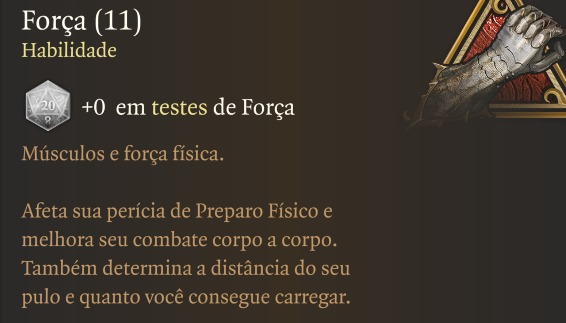
In the example above, the description of “Strength” in Baldur’s Gate 3 would be problematic if we took traditional grammar too strictly: The possessive pronoun “seu” used in the text is expected to refer to a third person (his), but the very last sentence says “você”, revealing that the text is actually targeting the player, not the character.
The possessive form prescribed by grammars would be “teu” (yours). But in reality, it is common for Brazilians to use “teu” and “seu” interchangeably for the second person, and say “dele” when we mean “his”, or “dela” when we mean “her”.
Closing Thoughts
In the end, the Brazilian localization specialist’s job is to balance the formal rules and the real language spoken by the people to create high-quality material.
We already know that localizing requires much more than converting words from language A to language B, and that understanding and respecting a culture is as important as mastering the language, but we must keep in mind that localizing demands as much creativity and attention to detail as the writing process itself.
Unofficial research done by the Iguana Institute shows that Portuguese players prefer to play a game in English or even Spanish instead of Brazilian Portuguese.
A Brazilian would find it very difficult to relate to European Portuguese.
We’re two very different siblings. We suggest localizing first to Brazilian Portuguese and then to European Portuguese if budget allows.
And forget about pleasing both worlds with one solution. This is a two birds, two stones scenario.